

Flats Without Families: The Silent Stress in Real Estate Markets
Why housing policy must shift from construction targets to real demand
Flats Without Families: The Silent Stress in Real Estate Markets
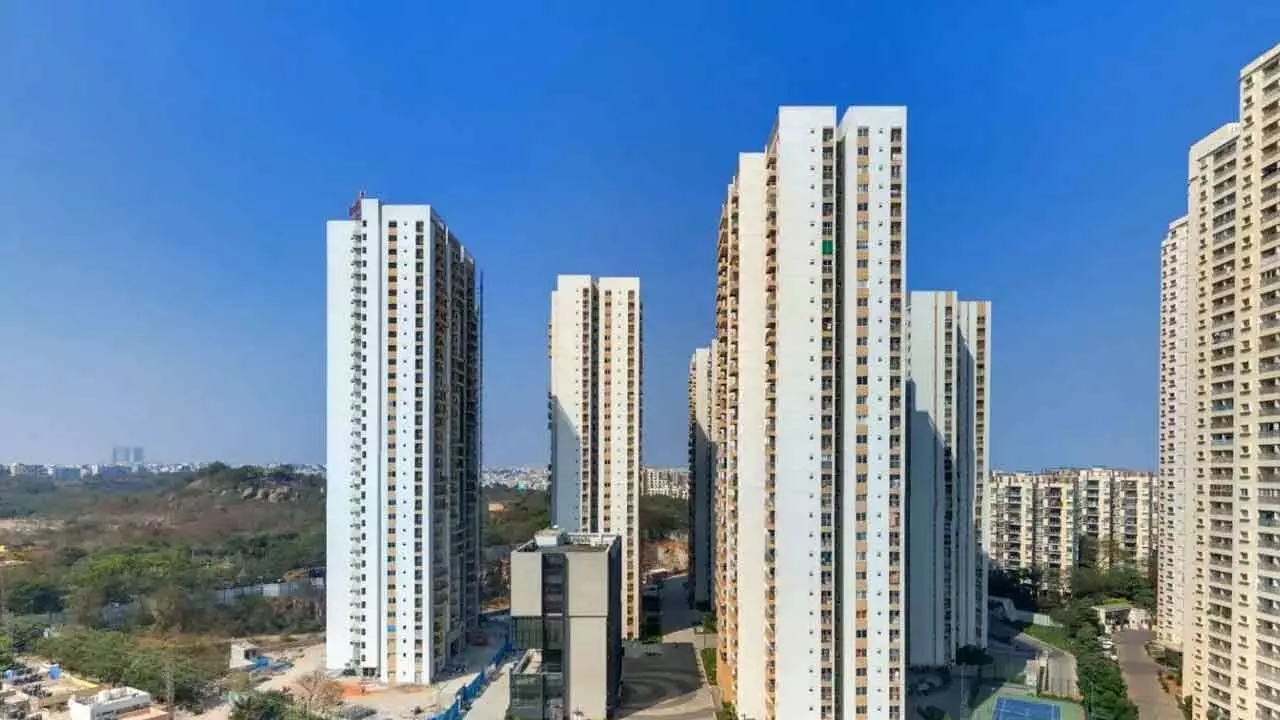

Real estate has long served as a bellwether of economic confidence. Yet today, in the absence of rigorous scientific assessment of demand and supply, both Gujarat and Telangana—particularly their urban hubs—find themselves at a crossroads.
In pockets, supply has clearly outpaced demand; investor enthusiasm is confronting ground-level caution; and traditional growth drivers no longer guarantee smooth journeys from blueprint to buyer. Unsurprisingly, inventory is piling up against a slower rhythm of real demand.
In Gujarat—especially in commercial centres like Ahmedabad and Rajkot—real estate performance reflects cautious optimism laced with unease.
Data from the Gujarat Real Estate Regulatory Authority shows that new project registrations fell from 1,858 in 2022–23 to 1,707 in 2023–24, before marginally rising to 1,822 in 2024–25. Officials concede that market sentiment remains weak, though they hope for improvement in the new financial year.
Developers privately admit that residential sales have slowed due to oversupply. Many have delayed fresh launches, while buyers who pre-booked flats are facing waiting periods of three to four years.
This has pushed homebuyers towards ready or near-ready properties—even at a premium—to avoid the risks associated with incomplete projects.
In Rajkot, municipal authorities have stopped approving residential buildings with decorative flower beds or projected balconies, citing planning constraints. As a result, around 60 ready residential projects remain undelivered due to delays in building-use approvals.
In Surat, new project launches have declined by roughly 13%. The ripple effects of US trade tariffs—hurting the diamond and textile sectors—have dampened investor confidence, prompting developers to shift focus from apartments to plotted developments.
The situation in Ahmedabad, Gujarat’s capital, is more nuanced. While overall sales have risen during the current financial year, demand has not surged decisively.
Property prices have inched up by around 3%, and mid-range housing continues to find takers. However, this apparent stability masks deeper strains. Across Gujarat, unsold inventory has risen by nearly 10%, with many housing units still waiting for occupants.
Developers, meanwhile, are hedging their bets. While residential supply is being moderated, commercial real estate—particularly office and mixed-use complexes—has begun to show signs of recovery.
Increased floor space index (FSI) utilisation in urban Ahmedabad is also driving taller, denser developments, a strategy aimed at meeting demand without encouraging urban sprawl.
Yet Gujarat’s core challenge is not merely excess supply; it is a growing mismatch between product pricing and buyer capacity. In Tier-2 cities and peripheral markets, many potential buyers feel priced out, even as core city segments register only tepid growth.
Social media chatter and local market sentiment reflect a clear wait-and-watch approach—classic demand hesitation in the face of steady or rising supply.
Across state borders, Hyderabad presents a more complex evolution. Historically, the city’s real estate growth was anchored in strong end-user demand, driven by the IT sector, research institutions, and ancillary industries.
For years, residential absorption outpaced supply, placing Hyderabad among the country’s most robust property markets.
Recent data, however, tells a more ambiguous story. Several reports indicate sharp declines in sales volumes during certain periods, even as new launches were drastically curtailed.
Oversupply—especially in mid-range and luxury housing—became evident as global economic headwinds and local job uncertainties cooled investor sentiment.That said, Hyderabad’s trajectory is not one of uniform decline.
Official registration data and industry feedback suggest a gradual rebound, with steady month-on-month improvement through 2025 as buyers and builders cautiously reconnect. Notably, the premium housing segment—homes priced above `1.5 crore—has shown resilience, even growth, signalling continued interest from affluent end-users and long-term investors.
At the same time, concerns persist. Many units appear to be held as investment assets rather than lived-in homes. Price escalation in certain corridors seems driven more by speculative psychology than by income growth or employment expansion.
If real wages and job creation do not accelerate meaningfully, demand may remain structurally subdued.This leaves Hyderabad grappling with a dual challenge: premium housing sustains activity, while affordable and mid-market segments lag behind.
A glut of unsold units—particularly in outer corridors developed on speculative land purchases—has increased pressure on developers to offer discounts, flexible payment plans, and incentives to attract genuine end-users.
What, then, connects Gujarat and Hyderabad despite their differing contexts? In both cases, developers responded to earlier optimism with ambitious supply pipelines, overshooting what actual end-user demand could absorb.
While affordable housing struggles, luxury residences and new-age commercial projects find pockets of resilience—creating segmentation rather than broad-based growth.
In several micro-markets, transactions are driven more by investment psychology than by habitation needs, resulting in inventory that is technically “sold” but functionally empty. This distortion undermines the health of urban ecosystems.
Both markets underscore a critical shift: real estate can no longer ride on linear growth expectations. Buyers demand value, transparency, and affordability; developers must realign products with genuine demand; and policymakers must place housing affordability and demand generation at the heart of urban growth strategies.
At this juncture, real estate must evolve beyond being a mere asset class for the affluent. It must become a system rooted in real demand—homes people live in, offices where businesses thrive, and cities that grow inclusively, sustainably, and resiliently into the future.
(The author is a former Chief Editor at The Hans India)





